
Electronic components for Industrial IoT: connectivity, security, and efficiency in smart projects
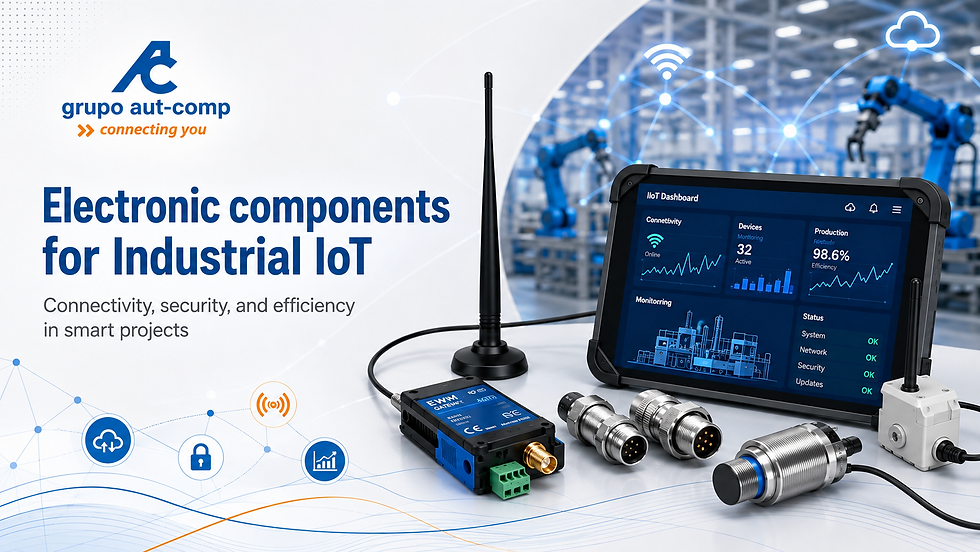
Industrial IoT, also known as the Industrial Internet of Things, has transformed the way companies monitor processes, collect data, connect equipment, and make real-time decisions. In increasingly digital industrial environments, electronic components for Industrial IoT are essential for developing smart, connected, and reliable solutions.
Sensors, microcontrollers, communication modules, antennas, power supplies, connectors, protection components, and low-power solutions form the foundation of devices capable of collecting information, transmitting data, and integrating machines, systems, and platforms.
However, developing an Industrial IoT project requires more than connectivity. It is necessary to consider security, robustness, energy consumption, operating environment, reliability, component availability, and specialized technical support.
In this scenario, Grupo Autcomp acts as a partner for companies seeking electronic components, technical support, and technological solutions for connected projects across different industrial segments.
What is Industrial IoT?
Industrial IoT is the application of connected technologies in industrial environments. It allows machines, sensors, equipment, and systems to exchange data with each other, creating smarter, more efficient, and more monitorable processes.
In practice, Industrial IoT can be applied to:
Remote machine monitoring;
Predictive maintenance;
Asset tracking;
Energy control;
Process automation;
Production management;
Environmental monitoring;
Temperature, pressure, flow, and vibration control;
Integration between sensors, equipment, and cloud systems.
With these solutions, companies can obtain real-time data, identify failures in advance, reduce unplanned downtime, and improve operational efficiency.
Which electronic components for Industrial IoT are important?
Every connected device depends on electronic components capable of collecting, processing, protecting, and transmitting information securely.
In an Industrial IoT project, component selection directly impacts factors such as communication range, energy consumption, signal stability, product service life, environmental resistance, and application reliability.
A sensor installed in a factory, for example, may operate in locations with electrical noise, vibration, high temperature, dust, humidity, and electromagnetic interference. Therefore, components must be selected with attention to real operating conditions.
When the selection is made correctly, the project gains performance, security, and operational continuity.
Main components used in Industrial IoT projects
Industrial IoT projects usually combine different families of electronic components. Each one plays a strategic role in system operation.
Sensors
Sensors are responsible for collecting information from the environment or from the monitored equipment. They transform physical quantities into electrical signals that can be processed and transmitted.
Among the most commonly used sensors in industrial applications are:
Temperature sensors;
Pressure sensors;
Current sensors;
Flow sensors;
Vibration sensors;
Magnetic sensors;
Optical sensors;
Humidity sensors;
Presence sensors;
Position sensors.
Choosing the right sensor depends on the measured variable, required accuracy, operating environment, communication interface, and expected service life.
Microcontrollers and embedded processors
Microcontrollers and processors are responsible for local information processing. They receive data from sensors, execute control logic, manage communication, and can make decisions directly on the device.
In Industrial IoT applications, it is important to evaluate performance, energy consumption, memory, available interfaces, embedded security, compatibility with communication protocols, and development support.
Communication modules
Connectivity is one of the pillars of Industrial IoT. Communication modules allow devices to send and receive data through different technologies.
Among the most common options are:
Wi-Fi;
Bluetooth;
Cellular IoT;
LoRa;
Zigbee;
Ethernet;
industrial protocols;
serial communication;
low-power, long-range networks.
The choice of technology depends on the required range, data rate, energy consumption, available infrastructure, industrial environment, and security requirements.
Antennas
The antenna is an essential component for ensuring performance in wireless systems. Even a good communication module may become unstable if the antenna is not suitable for the application.
When choosing an antenna, it is important to consider frequency, gain, positioning, mounting type, installation environment, nearby interference, and mechanical integration into the product.
In industrial projects, antenna performance can directly impact communication reliability.
Power supplies and energy management
Industrial IoT devices can be powered by the electrical grid, batteries, industrial power supplies, or embedded energy systems. Therefore, energy management must be considered from the beginning of the project.
Power supplies, DC/DC converters, regulators, battery chargers, and protection components help ensure stable, efficient, and safe power.
In battery-powered applications, low energy consumption is even more important, as it directly impacts device autonomy and maintenance.
Connectors and interfaces
Connectors are used to integrate sensors, boards, power supplies, cables, antennas, modules, and external interfaces. In industrial environments, they must provide mechanical robustness and electrical reliability.
It is important to evaluate current, voltage, mounting type, vibration resistance, connection cycles, environmental exposure, and ease of maintenance.
Protection components
Industrial IoT devices may be exposed to electrical surges, electrostatic discharges, noise, voltage variations, and electromagnetic interference.
Therefore, components such as TVS diodes, varistors, fuses, PTCs, capacitors, inductors, and EMI filters are important to protect the circuit and increase product service life.
Important factors when choosing components for Industrial IoT
Choosing electronic components for Industrial IoT should consider technical requirements, application environment, and project continuity.
1. Reliability in industrial environments
Industrial environments can be harsh. Temperature, vibration, dust, humidity, electrical noise, and continuous operation require more robust components.
That is why it is important to choose items suitable for the application, with specifications compatible with real operating conditions.
2. Low energy consumption
In many Industrial IoT projects, especially remote sensors and battery-powered devices, energy consumption is a decisive factor.
Microcontrollers, communication modules, sensors, and power supplies should be evaluated considering low-power modes, energy efficiency, and operating strategy.
A well-designed energy architecture can increase autonomy, reduce maintenance, and improve the viability of the solution.
3. Data security
Connected devices need to consider security from the beginning of development. In industrial applications, machine, production, and operation data can be sensitive.
Therefore, it is important to evaluate security features in microcontrollers, communication modules, protocols, authentication, encryption, and firmware updates.
Security should not be treated as an add-on, but as part of the project architecture.
4. Communication stability
An Industrial IoT solution depends on reliable communication. Interference, physical obstacles, distance, electromagnetic noise, and antenna positioning can affect performance.
Therefore, the choice of module, antenna, and protocol should be based on the installation environment and application requirements.
5. Protection against EMI, ESD, and surges
Devices installed in industrial environments can suffer from interference and electrical transients. Proper protection helps prevent field failures and increases product durability.
Filters, suppressors, grounding, PCB layout, and protection components should be considered during development.
6. Availability and lifecycle
Industrial projects usually have a long service life. Therefore, it is essential to evaluate component availability, lifecycle, manufacturer support, and possible alternatives.
This analysis reduces obsolescence risks and helps avoid future production issues.
7. Specialized technical support
Industrial IoT projects involve different technical areas: sensors, communication, energy, security, protection, firmware, layout, and integration.
Relying on specialized technical support helps choose the right components, reduce risks, accelerate validations, and find compatible alternatives for each application.
Industrial IoT and predictive maintenance
One of the most relevant applications of Industrial IoT is predictive maintenance. With connected sensors, it is possible to monitor machines and identify signs of wear, overheating, abnormal vibration, or failures before unexpected downtime occurs.
This type of solution depends directly on reliable electronic components. Accurate sensors, stable communication, efficient power, and proper protection are essential to ensure consistent data.
With real-time information, companies can plan maintenance, reduce costs, and increase equipment availability.
Industrial IoT and operational efficiency
In addition to predictive maintenance, Industrial IoT contributes to improving operational efficiency.
Connected devices can help with energy monitoring, process control, asset tracking, productivity analysis, and system integration.
For these benefits to be achieved, devices must operate reliably in the industrial environment. This reinforces the importance of choosing the right electronic components.
The role of Grupo Autcomp in Industrial IoT projects
Grupo Autcomp supports companies that develop connected solutions for industrial environments by offering electronic components, technical support, and access to global technology brands.
With operations in segments such as industrial, automotive, energy, telecommunications, lighting, IoT, and medical, the Group contributes to choosing suitable solutions for different applications.
Grupo Autcomp’s technical support helps companies evaluate components, compare alternatives, analyze connectivity, protection, energy, and availability requirements, reducing risks in the development of electronic projects.
This support allows companies to move forward with Industrial IoT projects with more security, reliability, and efficiency.
Conclusion
Industrial IoT is driving a new phase of automation based on data, connectivity, and embedded intelligence. For these solutions to operate safely and continuously, the choice of electronic components is essential.
Sensors, microcontrollers, communication modules, antennas, power supplies, connectors, and protection components should be selected considering performance, operating environment, energy consumption, security, and lifecycle.
Companies that rely on specialized technical support can develop more robust, connected solutions that are prepared for the challenges of industry.
If your company is looking for electronic components for Industrial IoT projects, contact Grupo Autcomp and count on specialized technical support to find the ideal solution.
Grupo Autcomp: technology that connects. Quality that transforms.

Comments