
Industrial sensors: how to choose the ideal technology for each application
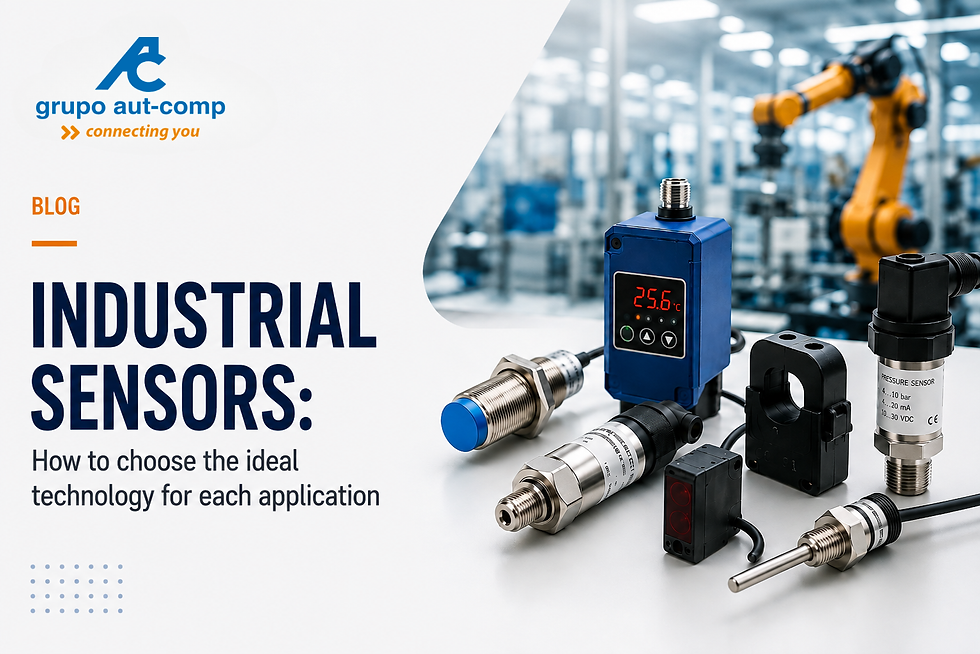
Industrial sensors are essential components for companies seeking greater control, efficiency, and safety in their processes. They are present in automation systems, machines, equipment, panels, production lines, energy applications, Industrial IoT, predictive maintenance, and remote monitoring.
In practice, industrial sensors are responsible for transforming physical variables, such as temperature, pressure, current, flow, position, presence, humidity, and vibration, into electrical signals that can be interpreted by electronic systems, controllers, and digital platforms.
With the advancement of Industry 4.0 and industrial connectivity, sensors are no longer just measurement devices. They now play a strategic role in data collection, process control, and decision-making.
However, choosing the ideal sensor for an industrial application requires attention to different technical factors: operating environment, accuracy, measurement range, signal type, power supply, communication, robustness, service life, availability, and technical support.
In this context, Grupo Autcomp acts as a partner for companies developing electronic and industrial projects, offering components, technical support, and solutions aligned with the needs of each application.
What are industrial sensors?
Industrial sensors are devices capable of detecting, measuring, or monitoring a physical condition and converting this information into an electrical or digital signal.
They function as the “senses” of industrial systems. Just as a machine needs commands to operate, it also needs information to understand what is happening in the process.
A sensor can identify, for example:
The temperature of equipment;
The pressure in a line;
The presence of a part;
The flow of a fluid;
The electric current of a motor;
The position of a component;
The vibration of a machine;
The humidity of an environment;
The proximity of an object.
This information allows control systems to make decisions, activate devices, generate alerts, record data, and help prevent failures.
Why are sensors important in industry?
In industrial environments, small variations can directly impact quality, safety, and productivity. That is why monitoring critical variables is essential to keep processes under control.
Industrial sensors help companies:
Increase operational efficiency;
Reduce equipment failures;
Improve process safety;
Prevent unplanned downtime;
Control quality;
Automate repetitive tasks;
Generate data for analysis;
Support predictive maintenance;
Reduce waste;
Improve decision-making.
When properly specified, sensors contribute to more reliable, intelligent systems that are prepared to operate in harsh environments.
Main types of industrial sensors
There are different types of industrial sensors, each suited to a specific variable or application. The correct choice depends on what will be measured, the operating conditions, and the project requirements.
Temperature sensors
Temperature sensors are used to monitor heating, thermal control, industrial processes, motors, power supplies, electrical panels, medical equipment, energy systems, and automation applications.
They help prevent overheating, control processes, and increase equipment service life.
When choosing this type of sensor, it is important to consider temperature range, accuracy, response time, packaging, installation environment, and compatibility with the electronic system.
Pressure sensors
Pressure sensors are used in hydraulic, pneumatic, industrial, automotive, medical, HVAC, pump, compressor, and control equipment systems.
They make it possible to measure the pressure of gases or liquids and convert this information into an electrical signal for control or monitoring.
When selecting a pressure sensor, it is necessary to evaluate measurement range, pressure type, accuracy, fluid compatibility, temperature, mechanical connection, and output signal.
Current sensors
Current sensors are used to monitor consumption, electrical load, motors, inverters, power supplies, batteries, energy systems, and industrial equipment.
They help identify overloads, failures, abnormal consumption, and operating conditions outside the expected range.
In industrial applications, it is important to evaluate rated current, measurement range, insulation, accuracy, dynamic response, operating temperature, and output type.
Flow sensors
Flow sensors measure the passage of liquids or gases through pipes, cooling systems, industrial processes, medical equipment, pumps, dosing systems, and hydraulic systems.
They are important for ensuring process control, safety, and operational efficiency.
When choosing a flow sensor, factors such as fluid type, minimum and maximum flow rate, pressure, temperature, contact material, accuracy, and system compatibility should be considered.
Position sensors
Position sensors indicate the displacement, angle, or location of a part, shaft, actuator, or mechanism.
They are applied in machines, robotics, automotive systems, industrial equipment, motion control, and automation.
Selection depends on the required accuracy, measurement distance, type of movement, environment, resolution, repeatability, and electrical interface.
Proximity sensors
Proximity sensors detect the presence of objects without physical contact. They are widely used in production lines, machines, conveyors, counting systems, positioning, and safety.
Common technologies include inductive, capacitive, magnetic, and optical sensors.
To choose correctly, it is important to evaluate the material to be detected, detection distance, response speed, operating environment, power supply, and output type.
Optical sensors
Optical sensors use light to detect presence, distance, interruption, color, position, or movement.
They are applied in automation, medical equipment, part counting, barrier detection, object detection, and safety systems.
When choosing an optical sensor, it is necessary to consider emission type, distance, ambient light, alignment, dirt exposure, response speed, and mounting format.
Magnetic sensors
Magnetic sensors detect magnetic fields or the presence of magnets. They are used in position, speed, rotation, opening and closing detection, motors, angular measurement, and automotive systems.
They are useful in applications that require contactless detection, high durability, and resistance to harsh environments.
Humidity sensors
Humidity sensors are used in environmental control, industrial equipment, HVAC systems, storage, agriculture, laboratories, medical equipment, and connected devices.
They help monitor environmental conditions that may affect processes, materials, and equipment.
Vibration sensors
Vibration sensors are widely used in predictive maintenance and machine monitoring. They make it possible to identify changes in the behavior of motors, pumps, compressors, bearings, and rotating equipment.
With this data, companies can detect failures before they cause unexpected downtime.
Where are industrial sensors applied?
Industrial sensors are present in several areas of industry and in different types of electronic projects.
Industrial automation
In industrial automation, sensors allow machines and systems to monitor processes in real time. They are used to detect parts, measure variables, activate devices, and feed control systems.
Industrial IoT
In Industrial IoT, connected sensors collect data from equipment, processes, and environments. This information can be sent to local systems or cloud platforms, supporting analysis, alerts, and strategic decisions.
Predictive maintenance
Vibration, temperature, current, and pressure sensors help identify signs of wear or failure in equipment. This allows companies to plan maintenance before unexpected downtime occurs.
Energy
In energy systems, sensors monitor current, voltage, temperature, flow, pressure, and environmental conditions. They contribute to the safety, efficiency, and reliability of power supplies, batteries, inverters, and distribution systems.
Automotive industry
Sensors are used in control, comfort, safety, energy efficiency, electrification, motor, battery, lighting, connectivity, and vehicle monitoring systems.
Medical equipment
In medical equipment, sensors help measure pressure, flow, temperature, position, presence, and other parameters that are essential for safety and accuracy.
How to choose the ideal industrial sensor?
Choosing the ideal sensor should take into account both technical requirements and actual application conditions. A sensor may have good specifications in the datasheet, but still not be suitable for the environment or system where it will be used.
1. Understand the variable that will be measured
The first step is to clearly define what needs to be measured or detected. Temperature, pressure, current, flow, position, presence, vibration, and humidity require different technologies.
It is also important to understand whether the measurement needs to be continuous, punctual, analog, digital, highly accurate, or only state detection.
2. Evaluate the operating environment
Industrial environments may include high temperatures, humidity, dust, vibration, electrical noise, electromagnetic interference, chemicals, or continuous operation.
Therefore, the sensor must be compatible with the actual installation conditions.
In some cases, reinforced packaging, protection rating, mechanical resistance, insulation, and materials suitable for the environment must be considered.
3. Define accuracy and measurement range
The measurement range indicates the limits that the sensor can monitor. Accuracy indicates how close the reading is to the actual value.
Choosing a sensor with an inadequate range can compromise system performance. Likewise, requiring very high accuracy when it is not necessary can increase cost and project complexity.
The goal is to find the right balance between performance, cost, and the real needs of the application.
4. Check the output signal type
Sensors can provide different types of output, such as analog, digital, PWM, serial, I2C, SPI, UART, current, voltage, or industrial signals.
The sensor output must be compatible with the circuit, microcontroller, controller, or data acquisition system.
This analysis helps avoid rework in electronic development and makes integration into the project easier.
5. Consider power supply and energy consumption
The sensor’s supply voltage and consumption must be compatible with the project’s electrical architecture.
In battery-powered applications, such as Industrial IoT devices, low power consumption is a decisive factor in increasing autonomy and reducing maintenance.
6. Evaluate response time
Some applications require fast response, such as presence detection in production lines, motion control, safety, protection, or dynamic monitoring.
Other applications, such as environmental control, can accept slower responses.
Understanding the required response time helps choose the most suitable technology.
7. Analyze robustness and service life
Industrial sensors must operate reliably over time. Therefore, it is important to evaluate service life, repeatability, mechanical resistance, stability, operating temperature, and application history.
A more robust sensor can reduce maintenance, prevent failures, and increase equipment availability.
8. Consider availability and lifecycle
In addition to technical specifications, it is essential to check whether the sensor is available, whether it has an adequate lifecycle, and whether alternatives exist for future production.
This analysis reduces the risk of obsolescence, production delays, and redesign needs.
9. Count on specialized technical support
Choosing industrial sensors can involve different technical variables. Specialized support helps evaluate options, compare technologies, review specifications, and select the most suitable component for each application.
Technical support is also important for identifying alternatives, optimizing the project, and reducing risks during development.
Industrial sensors and Industrial IoT
The evolution of Industrial IoT has further increased the importance of sensors. After all, every connected system needs reliable data to generate value.
Sensors installed in machines, motors, production lines, and industrial environments make it possible to collect real-time information and integrate this data into monitoring, control, and analysis systems.
As a result, companies can track operating indicators, identify anomalies, create alerts, predict failures, and improve process efficiency.
In this context, industrial sensors are the foundation of operational intelligence. Without reliable data, automation and IoT lose accuracy and efficiency.
The role of Grupo Autcomp in industrial sensor projects
Grupo Autcomp supports companies that develop electronic and industrial solutions with components, technical support, and access to global technology brands.
In industrial sensor projects, technical support is essential to evaluate the application, environment, interface, accuracy, availability, and integration with the electronic system.
With operations in segments such as industrial, automotive, energy, telecommunications, lighting, IoT, and medical, Grupo Autcomp helps companies find suitable solutions for different needs.
The Group’s role goes beyond supply. Specialized support helps with component selection, alternative analysis, solution development, and production continuity.
Conclusion
Industrial sensors are essential for transforming physical variables into useful data for control, automation, and decision-making.
The correct choice of sensor directly impacts the efficiency, safety, reliability, and operational continuity of the project.
To select the ideal technology, it is important to consider the measured variable, operating environment, accuracy, measurement range, output signal, power supply, consumption, response time, robustness, availability, and technical support.
If your company is looking for industrial sensors or electronic components for automation, Industrial IoT, energy, or monitoring projects, contact Grupo Autcomp and count on specialized technical support to find the ideal solution.
Grupo Autcomp: technology that connects. Quality that transforms.
Comments